Chapter 1 of 13
You Can't See Your Own First Impression
You Wrote It, So You Can't See It
You are in love with your resume. All job seekers are.
Not romantically. Functionally. You wrote it. You lived every line on it. You know the context behind every bullet, the effort behind every project, the person behind the page. To you it isn't a document, it's you, on paper. And it looks great, because you read it with everything you already know about yourself quietly filling in the blanks.
That is exactly the problem. The one person who can never see how your resume actually lands is you.
The person on the other side (a recruiter, a hiring manager) has none of your context. They have a few seconds and a stack of two hundred more. They don't see who you are, they see the page, cold, for the first time, with nothing filled in. And what the page says in those first few seconds is almost never what you think it says.
What They Actually See
Here's what that looks like, because it's worth being specific. Is the page dense, wall-to-wall text, or does it breathe? Bullet points or paragraphs? Is there a summary up top, or do they have to hunt for what you even do? Do the right keywords jump out, or do they have to read closely to find them? Where did you go to school, and does that name mean anything to them on sight? Which companies have you worked at, and are any of them ones they already recognize, Google, a name-brand, or something they've never heard of and have no context for? Does it look put together, or does it look like a template nobody bothered to adjust? Is there a photo, and what does it say before a single word does? None of that is who you are. It's what registers in the time they give it, and it decides everything that happens next.
I kept meeting people who were good at what they do and completely invisible on paper. They'd send out a hundred applications, hear nothing back, and have no idea why, because from the inside their resume looked perfect. They weren't wrong about themselves. They were blind to their own first impression.
“The one person who can never see how your resume actually lands is you.”
Five to Seven Seconds
There's real data behind how short that window is. Eye-tracking research on recruiters, first documented by Ladders and reconfirmed by more recent industry surveys, puts the average initial scan somewhere between five and seven seconds. Within that sliver of time, most of their attention goes to a handful of things: your name, your current title and company, your last title and company, the dates, your education. Everything else, the part that's actually you, barely gets a glance.
The Mirror I Built
So I built a way to show it to job seekers. I called it 7 Seconds, after that number, because that's the window this whole fight happens in. It ran at 7seconds.co.il, free, an experiment more than a product: upload your resume, and it reflected back what it triggered in that window. Enough people used it that it made television — I was invited onto the TV10 channel to talk about it. The live scan isn't running anymore, but the engine itself is public: I open-sourced the full prompt on GitHub, free for anyone to take, adapt, or build into their own tool.
7 Seconds did exactly one thing: it showed you what a resume triggers in the first few seconds someone reads it. No advice. No score. No fixing. Just the mirror, the thing you cannot see about yourself, made visible.
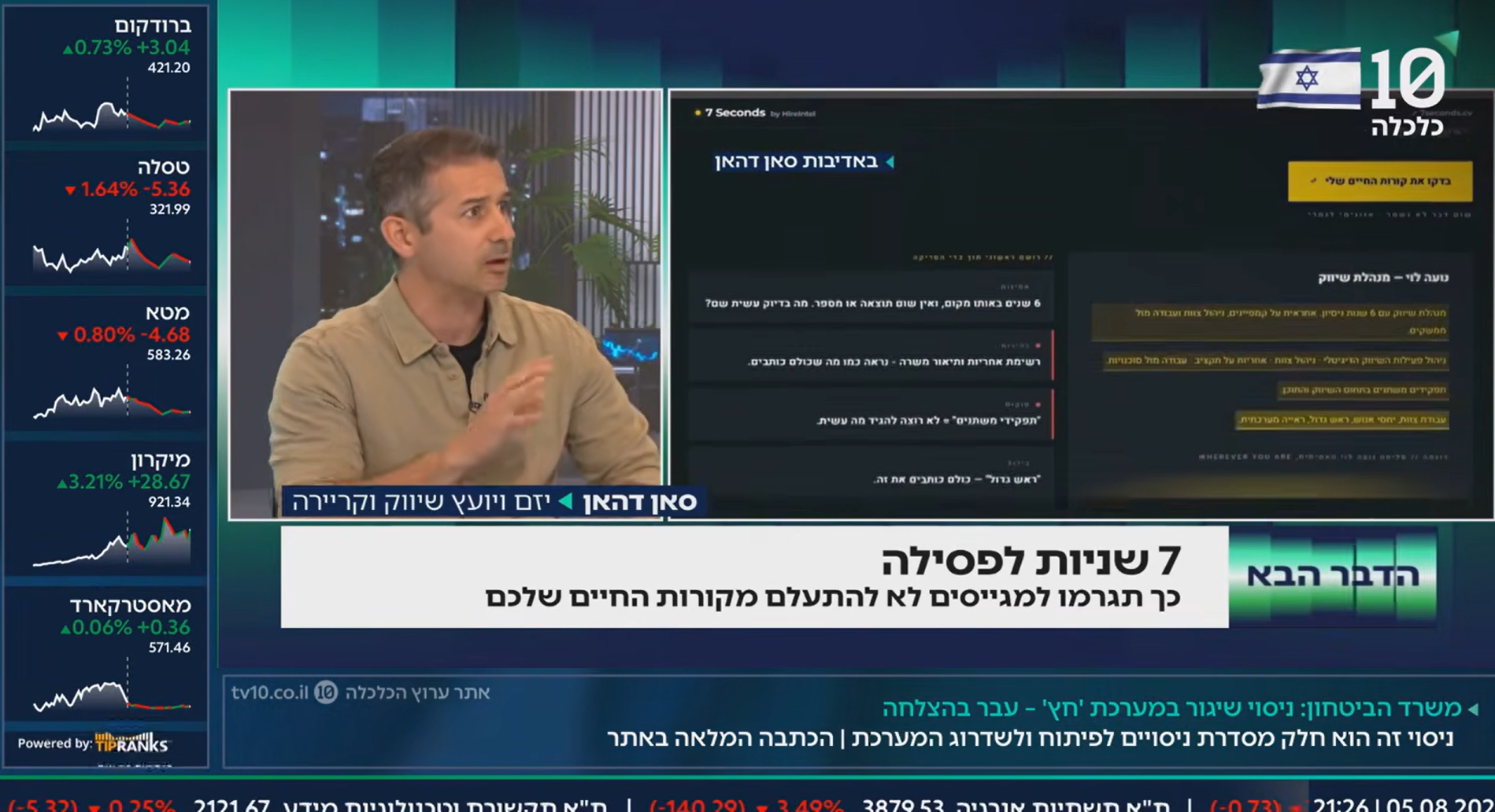
And in 2026 it matters more than ever. Most resumes are now written with AI (or at least with AI assistance), which means most of them sound the same. Recruiters report a flood of look-alike applications. The page has never been a weaker signal, and people have never been more attached to it.
This is the method behind everything in this thesis. I don't just believe there's a gap between who someone is and what their page shows. I built the mirror that makes it visible, and I watched hundreds of people see their own reflection for the first time. What they saw wasn't the person they are. It was the person the page makes them look like.
That gap, between who you are and what your page says, is where this whole thing begins.
Sources
- TheLadders, “Eye-Tracking Study: How Recruiters View Resumes,” 2018. Average initial resume scan: 7.4 seconds, mostly spent on name, titles, dates, and education.
- Harvard Business School / Accenture, “Hidden Workers: Untapped Talent.” 88% of employers admit their own ATS screens out qualified candidates over exact-keyword mismatches.
- ZipRecruiter, “More Jobs, Higher Bar: The 2026 AI Employer Report.” 48% of TA professionals say AI increased applications per role; only 24% can reliably spot an AI-written one.
Q&A
What does "you can't see your own first impression" mean?
You read your resume with everything you already know about yourself filling in the gaps, so it looks complete. A stranger reads it cold, in seconds, with none of that context — and sees something different.
How can I see what my resume looks like to a stranger?
Most people can't on their own, since they read it with context a recruiter never has. One approach: ask someone who doesn't know your work to read it cold and tell you their real first reaction. That's the exact gap a free experiment called 7 Seconds was built to close, named after the real average scan time, it showed people what their resume triggered in a recruiter's first few seconds. The live tool is retired now, but the engine is open-sourced on GitHub for anyone to use.
How long do recruiters spend looking at a resume?
Around five to seven seconds on average, according to eye-tracking research. Most of that attention goes to a handful of things: name, current and previous titles and companies, dates, and education — not the parts that show who you are.